Where can I play a Tesla Roadster game online?
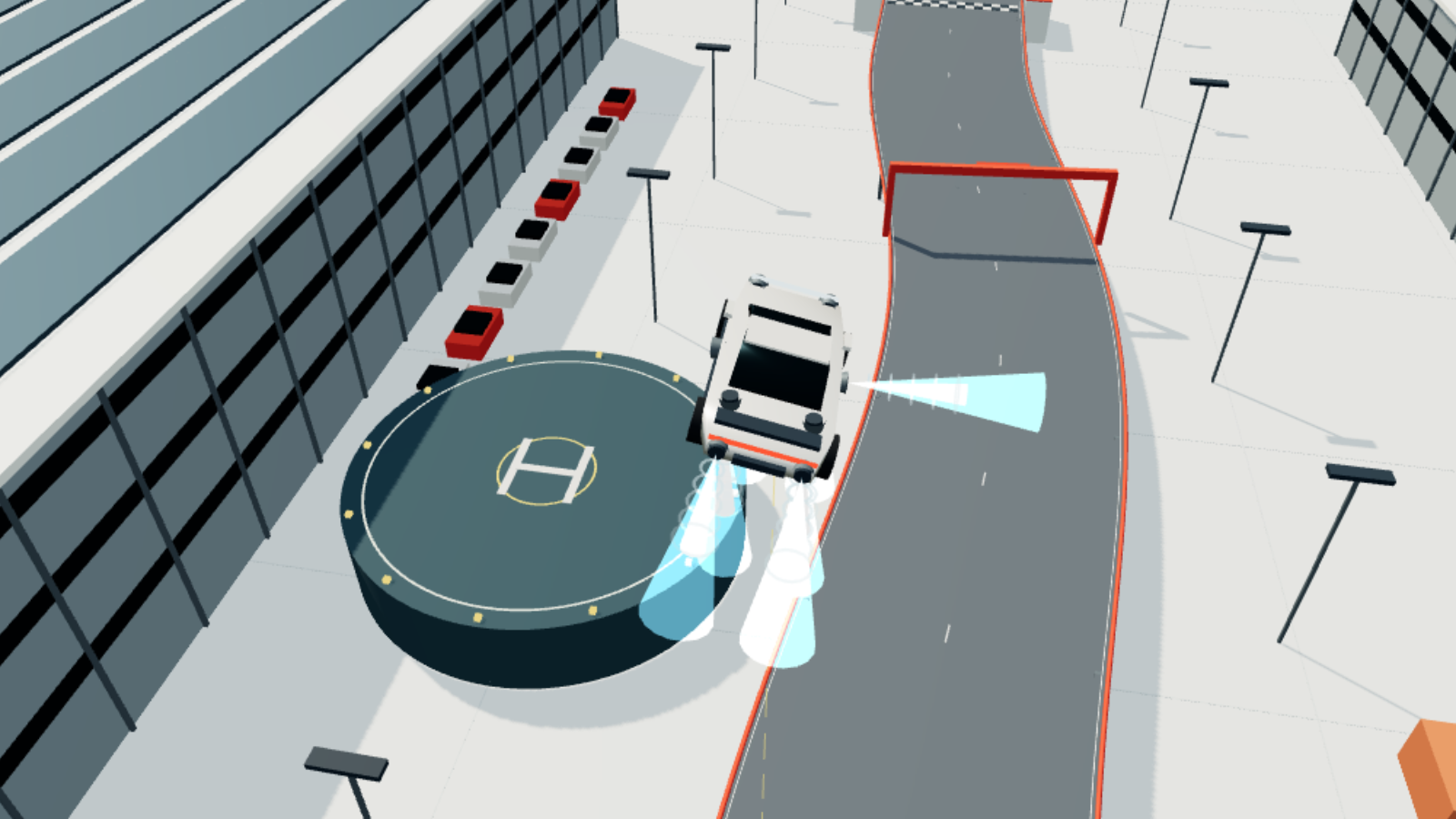
Play Flying Roadster on WASD Today, a free Tesla Roadster-inspired browser game. Drive up an inverted ramp, control the thrusters, and try to land on a helipad. Choose Easy, Medium, or Hard, or explore unlimited freestyle. No account or installation is needed.
Is this a realistic Tesla Roadster simulator?
Flying Roadster is an independent arcade game, not an official Tesla product or a validated engineering simulator. It models a moving car, thrust, rotation, and landing forces, but its track, helipad, and flight assistance are invented for play. It cannot establish how a production Roadster would perform.
Can I fly, flip, and land the Roadster myself?
Yes. Use WASD to drive and steer, the arrow keys for flight, and Space for forward boost. Q/E rolls the car and I/K flips it. Easy mode provides forgiving world-relative flight; Medium and Hard make thrust follow the car’s orientation. Freestyle lets you experiment with unlimited thrusters.
A sports car climbs a ramp, hangs upside down, and leaves the road behind. That sounds like the opening of a racing game. This time, it was the idea behind Tesla’s Roadster demonstration: combine a car with systems that can help it grip a surface and push it through the air.
At its October 15 reveal, Tesla showed short airborne stunts. The event took place at SpaceX’s test site in McGregor, Texas, near Waco. Our game starts with the same surprising question as the footage: what happens when a car reaches the end of the road and still has somewhere to go? The real answer involves air pressure, carefully directed forces, and a landing that matters just as much as the launch. [3]
What actually happened on the ramp?
Tesla’s official ramp video shows the car approaching a tall curved track. As it climbs, the road bends overhead. The car follows the surface, leaves the ramp, rotates in the air, and returns to the ground on its wheels. The clip includes different views of the stunt, so the changing camera angles should not be mistaken for separate tests. [1]
It helps to split the sequence into three jobs. First, the car must keep contact with the ramp. Next, it must control its position once its wheels no longer have a road to push against. Finally, it must reach the ground in a position that allows it to land. Those are different problems. A system that helps with one part does not automatically solve the other two.
How does a car stick to an upside-down road?
Car and Driver’s engineering report describes fans that remove air from beneath the Roadster, helping it stay pressed against the surface. It also describes compressed-air thrusters for movement in the air. These are separate systems: one helps the car grip the track, while the other can push the car when the track is gone. [2]
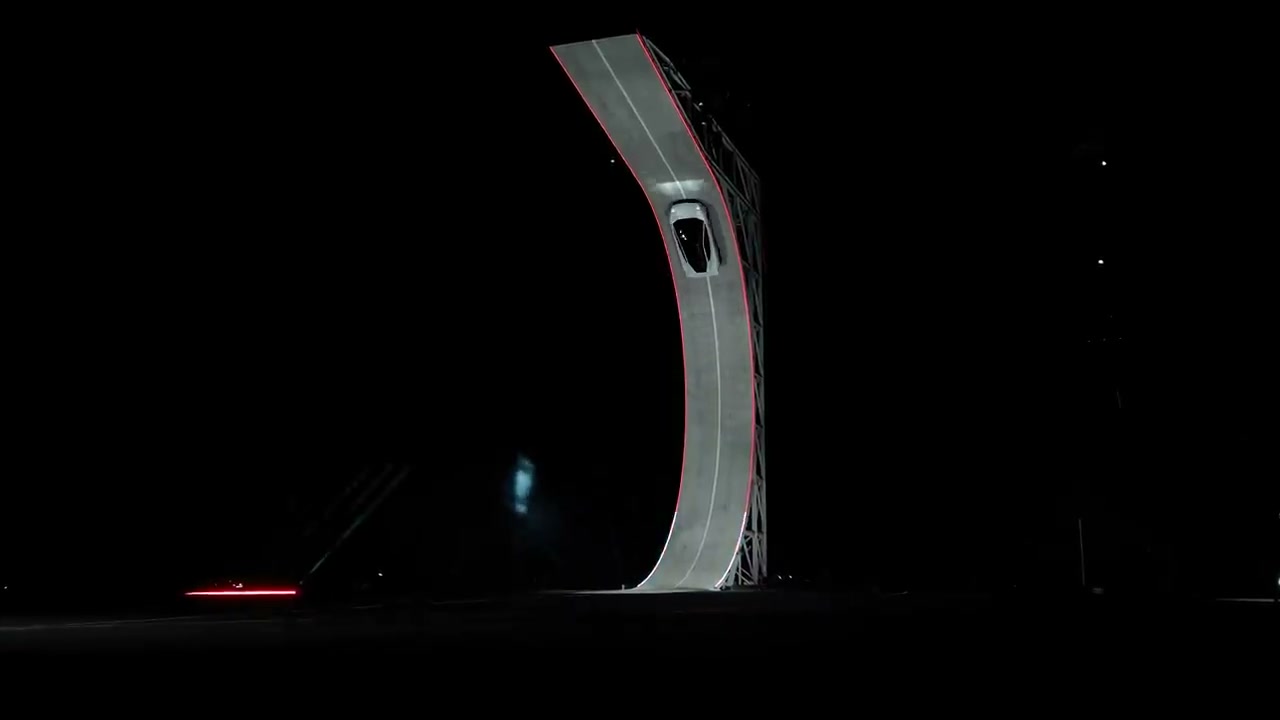
Here is the basic pressure idea. Air pushes against surfaces. If the pressure on one side is lower than on the other, the forces do not balance. The higher-pressure side pushes harder. On a suitable surface, reducing pressure in the space beneath a car can create a force toward that surface. NASA’s air-pressure guide explains the relationship between pressure, force, and area. [5]
That is why “downforce” can be a confusing name when the road turns upside down. Think of it as force toward the track. On a normal road, that direction is toward the ground. On the underside of a ramp, it is toward the ramp above the car. The trick is changing the forces acting on the car, rather than switching gravity off. Keeping a useful pressure difference is an engineering problem; a video alone cannot tell us how well the system would work on every possible surface.
What do the thrusters do after takeoff?
Once airborne, a car cannot steer just by turning its front wheels. Without contact with a road, the tires have nothing to push sideways against. The stunt therefore needs another way to change the car’s movement. Tesla’s demonstration uses jets of compressed air, rather than the burning fuel that people often picture when they hear the word “rocket.” [2]
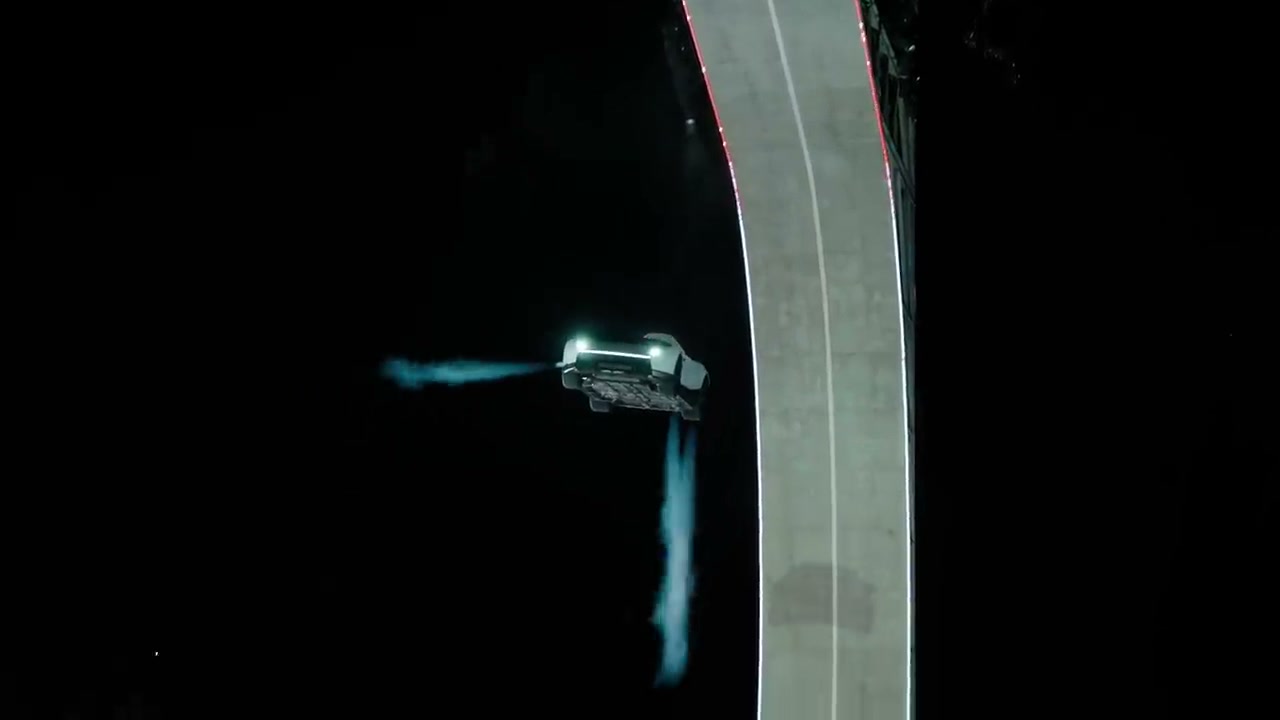
The basic rule is familiar from a balloon released before it is tied shut. Air goes one way and the balloon moves the other way. Newton’s third law describes the paired forces behind this effect. A vehicle that pushes gas in one direction receives a push in the opposite direction. Where those pushes act also matters: changing which part of an object receives a push can help change the way it turns. [6]
Why is landing a separate challenge?
Pointing the right way is only part of a landing. A vehicle can be level while still moving sideways or falling quickly. It needs to reach the landing area with a suitable direction, speed, and orientation. Changing any of those takes force and time. NASA’s explanation of motion connects a change in speed or direction to the forces acting on an object. [6]
This is also what makes our game interesting. A dramatic flip might look great, but the challenge continues until the car reaches the helipad. You have to think about where the car is going, rather than only where its nose is pointing. The game gives you an easy way to experiment with that difference, without pretending to reproduce the real Roadster’s controls.
On your first attempt, try making small corrections instead of holding a direction for the whole flight. Notice whether you are still moving after you stop pressing a key. Then compare a landing where you arrive slowly with one where you reach the same spot too quickly. Those experiments are about understanding our arcade challenge. They are not instructions for operating the vehicle in Tesla’s demonstration.
Does this mean flying cars have arrived?
The footage shows a short stunt. It does not demonstrate a routine flight from home to school or between cities. Those would require answers to much bigger questions: how long can the vehicle remain airborne, how does it handle changing conditions, and what happens if something fails? These are questions raised by the demonstration, not capabilities we can measure from it.
There are also different Roadster configurations. Car and Driver reports a Performance version, a Thrust version with rear thrusters, and a Rocket version with additional thrusters for aerial movement. The outlet also reports that Rocket is not approved for public road use. A feature shown on the stunt vehicle should not be assumed to come with every Roadster. [3] [2]
What still needs proving?
Tesla reported acceleration from 0 to 60 mph in under a second. That is a company performance claim, not a result tested by WASD Today. Musk also gave 2028 as a production target. A target describes a plan; it is not a guarantee that customers will receive a particular car on a particular date. [4] [3]
For now, keep three things separate when watching: what the footage visibly shows, what Tesla says its technology can do, and what remains to be tested or delivered. That lets you enjoy an unusual engineering demonstration while still asking useful questions. The most exciting clip can be the start of understanding a machine, rather than the whole explanation.
Where the news ends and our game begins
Flying Roadster is our independent arcade challenge. The helipad, flight assistance, and game physics are inventions for play. Tesla’s footage inspired the setup; it does not validate the game as a driving lesson or an engineering simulation. Try a careful landing, experiment with the controls, and see how much harder it gets when you arrive at the right place with the wrong speed.
Try the free landing challenge ↑- 01 · PRIMARY FOOTAGETesla — The Ramp | Roadster ↗
Also watch The Kickflip and the full reveal event.
- 02 · ENGINEERING EXPLAINERCar and Driver — How the thrusters and fan system work ↗
October 17, 2026 · Explains the suction system and compressed-air jets.
- 03 · REVEAL REPORTCar and Driver — New Roadster revealed ↗
Updated October 16, 2026 · Configurations, the demonstration, and the production target.
- 04 · NEWS COVERAGEEuronews — The Roadster demonstration ↗
October 16, 2026 · Event coverage and Tesla’s performance claims.
- 05 · THE SCIENCENASA Glenn — Air pressure ↗
Background on pressure, force, and surface area.
- 06 · THE SCIENCENASA Glenn — Newton’s laws of motion ↗
Background on forces, acceleration, and action and reaction.
Sources checked October 17, 2026. Demonstration footage is not independent vehicle testing.